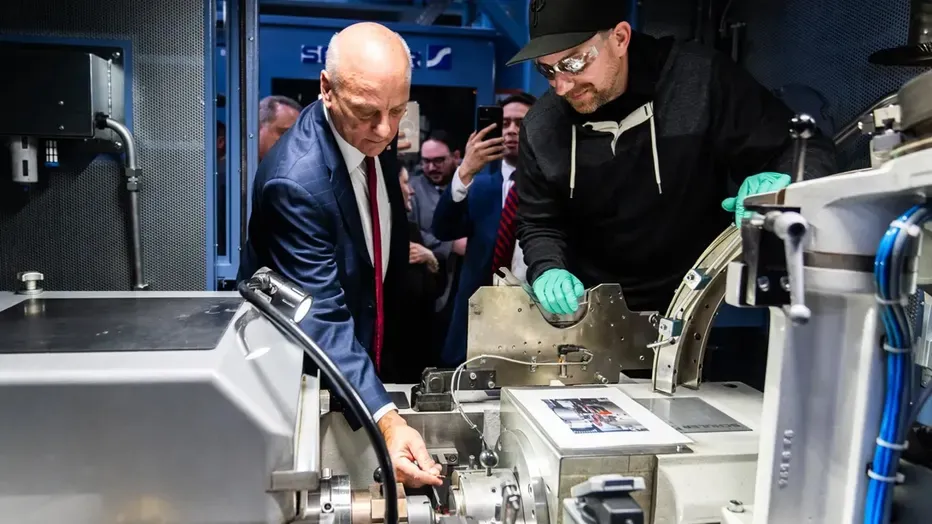
After 232 years in production, the U.S. penny has entered its endgame. In late 2025, the Treasury ceased minting one-cent coins, a historic first since the half-cent was retired in 1857.
Note: This article analyzes observed conditions, existing pressures, and operational realities, not legislative or regulatory predictions. Market responses and policy outcomes remain uncertain and vary by jurisdiction.
As we begin 2026, pennies remain legal tender and billions still circulate, yet businesses and consumers face a rounding standard vacuum. No federal law or regulation currently dictates how to round cash transactions now that pennies are no longer produced, leading to varied approaches across retailers. This article examines the economic, regulatory, and operational conditions surrounding the penny's phase-out, and the pressures shaping cash rounding practices in 2026.
The Economic Rationale
The economic rationale for retiring the penny was clear-cut. For years, it cost far more than one cent to produce each penny, about 3.7 cents per coin as of 2024. The U.S. Mint lost $85.3 million in 2024 alone minting pennies, a net negative known as seigniorage loss. This trend worsened with rising metal prices (97.5% zinc content) and inflation in manufacturing costs. As cash usage dwindled to less than a quarter of daily transactions, the penny's utility no longer justified its expense.
Political Context
Political commentary at the time reflected shifting views on the penny's value:
"For far too long the United States has minted pennies which literally cost us more than 2 cents. This is so wasteful!"
The Treasury announced cessation of penny production in 2025. The U.S. Mint placed its final order for blank penny planchets in May 2025, and on November 12, 2025, U.S. Treasurer Brandon Beach struck the ceremonial last batch of pennies in Philadelphia. "Rising production costs and changing consumer habits had made continuing the penny financially untenable," Treasury noted, highlighting that minting a penny had more than doubled in cost over the past decade.
Congress had debated the penny's fate for years, with bills like the Common Cents Act citing that continuing penny production through 2028 would waste taxpayers an additional $225 million. The Treasury acted under existing legal authority (31 U.S.C. §5111) to suspend coin issuance. The penny joins a list of defunct U.S. denominations such as the 2-cent piece and the half-cent.
Crucially, pennies remain lawful currency even though the Mint has stopped making them. Over 100 billion pennies are estimated to be in circulation (far more than needed for commerce), so the coin will linger for years until naturally attrited. The question now is how to handle transactions when cash purchases don't sum to a multiple of 5 cents.
Current Conditions: Fragmentation and Operational Risks
With no new pennies being made, cash transactions are increasingly rounded to the nearest nickel (5¢). Absent a federal rule, 2025 saw a patchwork of responses from merchants, banks, and states.
Some businesses have adopted symmetrical rounding, rounding totals ending in 1¢, 2¢, 6¢, or 7¢ down and 3¢, 4¢, 8¢, or 9¢ up to the nearest 5¢, to balance out gains and losses over time. For example, a $10.98 cash sale rounds to $11.00, while $10.96 rounds down to $10.95. Major chains like McDonald's and Wendy's reportedly began symmetrically rounding at some locations in late 2025.3
Other retailers have taken a different approach: always rounding down in favor of the customer to avoid any appearance of overcharging.4 A number of convenience stores, franchises, and quick-serve restaurants instructed their outlets to round down if pennies are not available, effectively absorbing the 1–4 cent difference as a goodwill gesture.
Legal and Compliance Considerations
Not all guidance has been consistent. Many franchise vs. corporate policies diverged, with some franchisees hesitant to incur losses from rounding down, even as corporate HQs recommended it to mitigate legal exposure. The lack of uniform rules has raised significant legal and compliance considerations.
Consumer protection laws in several states (e.g., cash transaction fairness acts) prohibit charging cash payers more than the posted price, which complicates any rounding-up practice. Legal observers note that a retailer who always rounds up on cash transactions could face class-action lawsuits for effectively overcharging customers.
"The payments to the class [in such suits] may be small, but the payments to the lawyers are not."
Regulatory Gaps
Regulatory grey areas remain. For example, U.S. SNAP benefits (food stamps) legally cannot be treated differently from cash, yet if a grocer rounds down for cash customers but an EBT card (electronic) customer is charged the exact higher amount, questions arise about consistency. One expert noted "there's no way to square that circle" under current rules.
Sales tax remittance is another challenge: States like Georgia have issued guidance clarifying that merchants should calculate and remit sales tax on the original price before rounding, to avoid shortchanging state tax coffers. This means if a store rounds a $8.63 total down to $8.60 for the customer, the sales tax due is still based on $8.63. The merchant absorbs the 3¢ difference.
In short, the current post-penny landscape is fragmented. Consumers encounter different rounding practices at different stores, and many registers still show penny-inclusive prices even though the final cash due may differ. The lack of a national standard has left retailers navigating legal ambiguity, and even well-intentioned efforts to be fair (like always rounding down) carry costs that not all businesses will sustain indefinitely.
Observed Pressures and Possible Market Responses
This section describes observed pressures and illustrative responses, not forecasts. Actual market behavior depends on numerous factors that remain uncertain.
Awareness Pressures
In early 2026, public awareness efforts are underway. The U.S. Mint and Federal Reserve have communicated that pennies, though still usable, will gradually dwindle and that cash totals may be rounded. Large retailers are experimenting with posted notices (e.g., signs at checkout: "We no longer return pennies; totals will round to nearest 5¢").
Some states have proposed legislation mirroring Canada's rounding rules. Financial institutions are alerting their customers, and banks may offer to redeem hoarded pennies as they attempt to pull them out of circulation. During this period, however, practices remain inconsistent overall, and the awareness gap is still closing among the general public.
Fragmentation Pressures
By spring and early summer, the real-world problems caused by inconsistent rounding become more apparent. Reports of minor consumer frustrations tick up, and legal pressures may increase if businesses are perceived as profiting from rounding. Lawsuits or attorney-general warnings remain possible if any businesses are seen as systematically overcharging.
Industry groups like the National Retail Federation and National Grocers Association may issue guidance to their members to adopt symmetrical rounding as a safe harbor. In states that haven't set rules, businesses face pressure to align on consistent practices. Some states have considered legislation, though approaches vary. Federal legislation remains pending.
Convergence Pressures
By the second half of 2026, market pressures may drive increased consistency. The combination of several large states considering similar rounding approaches and major nationwide retailers voluntarily aligning their policies could lead to more uniform practices.
Symmetrical rounding to the nearest nickel has emerged as a common approach among early adopters. POS vendors have issued software updates enabling automatic rounding rules. The public is becoming accustomed to the idea that their $5.37 total may be $5.35 in cash or that $10.99 may be $11.00.
Possible Stabilization
By the end of 2026, rounding practices may become more consistent as infrastructure adapts. Absent federal guidance, state-level and industry-led approaches continue to shape behavior. Most cash registers, receipt printers, and price displays have been configured to handle no-penny transactions.
The Treasury may provide updates on penny redemption efforts. If consistent market practices emerge, it would be costly for any large retailer to deviate from established norms. The end of the year approaches the first holiday shopping season with widespread rounding practices in effect.
International Precedents
The United States is far from the first country to retire its lowest-denomination coin. Allies and trading partners have navigated this transition, offering useful precedents on both policy and public reaction:
Canada (2012)
In 2012, Canada ceased production of its penny, and the Royal Canadian Mint implemented a nation-wide rounding guideline. Prices are rounded to the nearest $0.05 for cash transactions only, with 1¢/2¢ rounding down and 3¢/4¢ rounding up (and likewise 6¢/7¢ down, 8¢/9¢ up). Non-cash payments continue to pay the exact amount to the cent.
Canada's approach was explicitly symmetrical: no net gain to businesses over time. Studies after 2012 found no evidence of inflationary impact from Canadian rounding; price levels did not measurably increase due to penny withdrawal. Canadians adapted quickly. By now, a decade later, the idea of a penny in circulation is mostly a memory, and cash transactions routinely round without fuss.6
Australia and New Zealand
These countries eliminated their 1¢ and 2¢ coins in the early 1990s (Australia in 1992, New Zealand in 1990) and, in New Zealand's case, even phased out the 5¢ coin in 2006. Both implemented rounding rules for cash similar to Canada's, and both found the public quickly embraced the change.
In Australia, the transition was aided by clear communications that final totals would round to 0¢ or 5¢ only, and that this does not apply to electronic payments. Retailers initially worried about consumer pushback, but that never materialized in force; shoppers appreciated not dealing with handfuls of low-value coins.
Notably, neither Australia nor New Zealand experienced rounding being used exploitatively by merchants; competitive pressures and consumer vigilance kept pricing honest, a finding that may inform expectations for the U.S. market.
Europe and Other Regions
Many Eurozone countries have implemented "Swedish rounding" (named for Sweden's long-ago practice) in places where 1- and 2-cent euro coins are scarce. The Netherlands and Finland, for instance, effectively stopped distributing 1¢ and 2¢ euro coins and mandate rounding to €0.05 for cash. Again, the approach is symmetric and well-publicized.
Ireland phased out its 1- and 2-cent coins in 2015 with a national rounding initiative. These examples reinforce the importance of clear public guidance: when people understand that sometimes they'll pay a couple cents more, other times a couple cents less, and it evens out, acceptance is high.
The broad takeaway from abroad: coin retirements are economically sound and logistically manageable when a clear, standardized method is in place.
Perspectives from Stakeholders
The penny phase-out has stirred debate among policymakers, economists, and advocacy groups. The following quotes reflect a range of perspectives:
"Sad to see the penny go, but it was inevitable given rising costs."
Beach, who presided over the final penny striking, emphasized that economic reality caught up to nostalgia. He acknowledged the penny's place in U.S. history even as it steps aside.
"Eliminating the coin is an absolutely horrible idea. It would be bad for consumers… not save money… [and] could increase government losses."
Weller's advocacy group has raised concerns about potential harms to consumers, suggesting that prices might creep up. The group points out that increased nickel production (at 14¢ cost each) might offset penny savings, and raises the possibility of a "rounding tax" on consumers if businesses mostly round up. These represent one perspective in the ongoing debate.
"My research finds that the last digit in the cash register total is random, so there would be as much rounding down as there is rounding up, and the customer won't be gouged, nor will there be an inflationary impact."
Whaples' 2006 study of thousands of transactions found consumers actually came out a tiny bit ahead on balance when rounding was applied, though the net was fractions of a cent per transaction, basically a wash. Federal Reserve research estimates the nationwide cost of rounding to be only ~$6 million/year, negligible in an economy of trillions.
"We have been advocating abolition of the penny for 30 years. But this is not the way we wanted it to go."
Retailers generally favor moving away from pennies (to speed up transactions and reduce handling costs), but many had hoped for an orderly phase-out with clear rules established in advance.
Emerging Implementation Approaches
In the absence of uniform federal guidance, the private sector and civil society have developed voluntary frameworks to promote consistency in rounding practices.
One example is Centsless, a neutral compliance framework that addresses how cash rounding operates when pennies are unavailable. It provides reference rules for deterministic rounding behavior, receipt formatting, and audit trails.
Banking and payments companies also have interests in this space. If cash transactions become smoother and trust in rounding grows, it supports continued cash acceptance rather than driving consumers away from cash.78
Implementation frameworks like Centsless operate independently of policy decisions. They address operational consistency regardless of which regulatory approach, if any, is eventually adopted. These frameworks take best practices from places like Canada and Australia, add U.S.-specific considerations (like sales tax quirks and $0.99 pricing psychology), and give merchants a reference implementation to follow.
Conclusion
The retirement of the penny reflects economic logic: it saves tens of millions annually, eliminates inefficient resource use, and acknowledges the coin's diminished purchasing power.
What remains uncertain is how operational consistency will be achieved. Absent uniform federal guidance, practices vary by merchant, jurisdiction, and system. International precedents suggest that clear, symmetrical rounding rules lead to smooth transitions, but implementation depends on local conditions.
The year 2025 brought the decision; 2026 is revealing how that decision plays out operationally. Early conditions suggest that despite some fragmentation, market pressures are pushing toward more consistent practices, aided by lessons from other countries and proactive moves by industry groups and states.
The challenge ahead is not predicting policy outcomes, but ensuring consistency, transparency, and auditability as rounding becomes operational reality. How organizations navigate this transition, with or without federal guidance, will shape the experience for merchants and consumers alike.
March 2026 Update: Conditions as of March 22, 2026
The Transition Is No Longer Hypothetical
When this analysis was published in January 2026, the fragmentation described in the timeline section was largely prospective. As of March 2026, it has arrived, and in some respects moved faster than anticipated.
Four states have now enacted cash rounding laws. Arizona's HB 2938 was signed by Governor Hobbs on March 14, 2026, taking effect immediately via emergency clause. Indiana's SB 243 was signed by Governor Braun on March 5, 2026, also effective immediately. Tennessee's HB 1744 was signed by the Governor on March 18, 2026. Washington's HB 2334 became law on March 23, 2026, notably using asymmetrical rounding methodology. Florida, Virginia, Oregon, Iowa, Hawaii, and Maryland have each passed bills through their respective chambers and are awaiting governors.
The federal Common Cents Act has since advanced: the House passed H.R. 3074 on July 14, 2026 and the Senate passed the companion bill, S. 1525, by unanimous consent on August 7, 2026. S. 1525 was received in the House on August 10, 2026 and awaits further House action before presentment to the President, so no federal rounding standard is in force. The fragmentation this analysis warned about, varied state approaches filling a federal void, is now the operational reality for multi-location operators.
A Critical Compliance Divergence
The most significant development since this article's publication is not the volume of state bills, but a fundamental methodological conflict between enacted laws.
Arizona mandates symmetrical (Swedish) rounding: totals ending in 1 cent or 2 cents round down to 0 cents, and totals ending in 3 cents or 4 cents round up to 5 cents. Indiana similarly applies symmetrical rounding as its standard. Washington state's HB 2334, sent to the governor on March 13, 2026, uses a different methodology: totals ending in 3 cents, 4 cents, 6 cents, or 7 cents round to 5 cents, while 8 cents and 9 cents round up to 10 cents. The methodologies are not interchangeable.
For a retailer operating locations in both Arizona and Washington, applying a single rounding rule across all locations means being inconsistent with the applicable rule in at least one jurisdiction. This is not a theoretical edge case; it is the current operating reality for any multi-state operator active in both states. The international precedents discussed earlier in this article succeeded precisely because they avoided this kind of sub-national fragmentation. The U.S. trajectory is different.
POS Vendors Have Responded, Partially
Major point-of-sale platforms have begun shipping rounding features. Square launched cash rounding functionality in December 2025, adapting infrastructure originally built for Canada and Australia. Shopify POS has automatic Swedish rounding available. Lightspeed offers configurable rounding in its retail systems.
What these implementations share is a single configurable rule applied uniformly across all of a merchant's locations. A merchant operating across Arizona and Washington cannot configure a single POS integration to be simultaneously compliant with both states' enacted requirements. The feature addresses the simple case. The compliance case, jurisdiction-aware, auditable, refund-normalized, remains unaddressed by any major POS vendor as of this update.
What the Data Now Shows
The Richmond Fed's July 2025 finding that the annual consumer rounding tax from penny elimination is approximately $6 million has been widely cited in legislative debate. That figure rises to an estimated $56 million annually if the nickel is eventually eliminated, more than nine times the penny impact. H.R. 1270, the Penny and Nickel Suspension Act, has been introduced in the current Congress. Treasury Secretary Scott Bessent testified in early 2026 that nickel production costs are under review.
The RILA survey of the 25 largest U.S. retailers found nearly 25 percent report more than 1,000 store locations completely without pennies. The National Restaurant Association estimates the restaurant industry is absorbing $13 to $14 million per month in rounding-related costs. Cash still represents approximately 14 percent of all U.S. consumer transactions per the Federal Reserve's 2025 Diary of Consumer Payment Choice.
Where Conditions Stand
The "mid-2026 fragmentation pressures" described in this article's original timeline have arrived earlier than projected and with greater legal specificity than anticipated. Twenty states with enacted cash rounding laws, additional states with formal DOR guidance, and approximately 28 states with active legislation represent a compliance landscape that changes materially week to week.
The conclusion of this article's original analysis stands: the challenge is not predicting policy outcomes, but ensuring consistency, transparency, and auditability as rounding becomes operational reality. What has changed is the urgency. Operators who treated this as a 2026 planning item now face enacted law with enforcement provisions. The window for preparation is not closing; it has closed in several states already.
Centsless tracks legislative developments across all 50 states in real time. View the Legislative Tracker →
Sources & References
- "US Treasury's last five minted pennies may spark multimillion-dollar bidding war." FOX 13 Tampa Bay.
- "US Mint presses final pennies as production ends." AP News.
- "The penny is out. Experts weigh in on what it means for consumers." Bankrate.
- Industry reports and analyst coverage on retail rounding policies, 2025.
- U.S. Mint Press Releases and FAQs; Federal Reserve Bank of Richmond analyses.
- "Budget 2012 - Rounding Guidelines." Government of Canada.
- "Credit Unions Prepare for Penny Elimination Impact on Members." LinkedIn.
- "Banks and retailers run short on pennies as the US Mint stops production." LinkedIn.
- Arizona HB 2938. Arizona State Legislature. Signed March 14, 2026.
- Indiana SB 243. Indiana General Assembly. Signed March 5, 2026.
- Washington HB 2334. Washington State Legislature. Passed both chambers March 2026.
- Florida SB 1074. Florida Senate. Passed both chambers March 2026.
- H.R. 3074, Common Cents Act. 119th Congress. House Financial Services Committee, July 2025.
- Wang, Zhu and Russell Wong. "Rounding Up: The Impact of Phasing Out the Penny." Federal Reserve Bank of Richmond Economic Brief No. 25-27. July 2025.
- National Restaurant Association. "Seeks Solutions to Operator Penny Problems." December 2025.
- Retail Industry Leaders Association. "Retailers Face Penny Shortages, Call for Federal Action." November 2025.
- Associated Press. "State lawmakers rush to set rounding rules for when there are no pennies." March 12, 2026.
- Spokesman-Review. "Washington tackles rounding rules as nation phases out penny." March 18, 2026.